Back to What is Business Analysis Section 2.3

Why It Matters

Business analysis delivers measurable organisational value through cost prevention, transformation success, and stakeholder alignment.

Cost Prevention

The True Cost of Poor Requirements: Beyond Budget Overruns

Requirements failures represent the single largest preventable source of project waste in modern organisations. The Project Management Institute calculates that companies waste twenty-eight per cent of project investments due to requirements-related issues—scope creep, feature churn, miscommunication, and costly rework cycles. For a five million pound digital transformation initiative, this translates to one point four million pounds lost to preventable failures that structured business analysis would eliminate.

These losses manifest in predictable patterns. Development teams build features that stakeholders didn't actually request because requirements lacked sufficient clarity. Software passes testing but fails user acceptance because acceptance criteria didn't reflect actual business conditions. Systems launch successfully but achieve minimal adoption because change management requirements were overlooked. Cloud migrations exceed budgets by three hundred per cent because current state analysis inadequately captured integration complexity.

Human Cost

The human cost extends beyond financial waste. Project teams experience burnout when requirements volatility creates endless rework cycles. Technical leads leave organisations frustrated by stakeholders who "keep changing their minds" (actually reflecting inadequate initial elicitation). End users resist adopted systems they perceive as imposed solutions rather than responses to their actual needs. Executive sponsors lose credibility when high-profile initiatives fail to deliver promised benefits.

BA Prevention Mechanisms

Business analysts prevent these cascading failures through systematic requirements management. They employ elicitation techniques that uncover unstated needs and hidden constraints. They create requirements documentation that both business stakeholders can validate and technical teams can implement confidently. They establish traceability matrices ensuring every requirement maps to business objectives and every feature maps to validated requirements.

Transformation Success

Digital Transformation Success: The Business Analyst Multiplier Effect

Digital transformation dependency on business analysis has intensified. Organisations attempting cloud migrations, AI implementation, or process digitalisation without structured business analysis report failure rates exceeding seventy per cent. These initiatives fail not because the technology doesn't work, but because organisations inadequately define what success looks like, fail to understand current state processes before redesigning them, and neglect change management requirements. Business analysts address these gaps through current state assessment, future state design, transition planning, and benefits realisation frameworks.

Without BA: Technical Exercise

Without effective business analysis, organisations typically approach migration by inventorying applications and determining cloud equivalents—a technical exercise. They migrate systems sequentially, discover integration dependencies mid-project, experience unexpected outages, and find that migrated applications don't deliver expected performance improvements. Budgets triple whilst benefits remain elusive.

With BA: Strategic Transformation

With structured business analysis, the same initiative transforms. Business analysts conduct current state assessment documenting not just applications but business processes those applications support. They perform stakeholder analysis identifying everyone affected by migration decisions. They facilitate workshops defining future state requirements—not just "move to cloud" but specific business capabilities the organisation needs cloud infrastructure to enable. They create detailed transition plans acknowledging that migrating the customer database requires parallel running the old and new systems whilst gradually redirecting traffic. They define benefits realisation frameworks measuring whether migrated systems actually deliver promised cost savings and performance improvements.

Three Success Mechanisms

The three primary mechanisms through which business analysis enables transformation success are stakeholder alignment, complexity management, and benefits realisation. Stakeholder alignment ensures that diverse groups agree on objectives before committing resources. Complexity management breaks overwhelming initiatives into sequenced phases with validated dependencies. Benefits realisation creates accountability for outcomes rather than just outputs—measuring whether the cloud migration actually reduced infrastructure costs by the projected forty per cent rather than simply confirming that migration occurred.

Real-World Evidence

Three Detailed Case Studies: Business Analysis Impact Across Industries

Case Study 1

Financial Services — Regulatory Compliance Platform

A multinational bank faced mounting regulatory pressure to improve anti-money-laundering transaction monitoring following industry-wide enforcement actions. The compliance department requested a "better system" for reviewing suspicious transactions, initially describing requirements as "faster processing" and "fewer false positives". Without effective business analysis, IT would have selected a vendor platform based on technical specifications and implemented it according to default configurations.

Instead, the assigned business analyst spent three weeks conducting detailed elicitation. She interviewed compliance analysts to understand their actual workflow, discovering they spent forty per cent of their time manually gathering customer information from disparate systems before even beginning substantive analysis. She observed live transaction reviews, noting that false positives stemmed not from insufficient system capability but from outdated customer risk profiles that analysts couldn't efficiently update. She facilitated workshops with compliance management, operations, legal, and IT to define requirements comprehensively.

BPMN-style process flow diagram showing AML transaction review workflow

BA Elicitation Phase

The business analyst employed interviews, observation sessions, and workshops to uncover the true requirements. She spent time understanding actual analyst workflows, identifying that forty per cent of time was wasted on manual data gathering rather than actual analysis work. This discovery fundamentally shaped the requirements specification.

Comprehensive Requirements

The resulting requirements specification went far beyond "faster processing". It defined requirements for automated customer profile enrichment pulling data from seventeen internal systems, integration with external sanctions screening databases, configurable risk scoring algorithms reflecting the bank's specific risk appetite, and workflow automation routing high-risk cases to senior analysts whilst simple reviews remained with junior staff. The specification included non-functional requirements: the system must process fifty thousand transactions daily with ninety-nine point nine per cent uptime, maintain complete audit trails for regulatory examination, and enable reporting across multiple jurisdictions with varying regulatory requirements.

Measurable Outcomes

Implementation following these comprehensive requirements delivered measurable outcomes. False positive rates decreased sixty-seven per cent, reducing wasted analyst time. Average case handling time dropped from six hours to ninety minutes. Most significantly, the system passed regulatory examination with zero findings, potentially saving the bank millions in enforcement penalties. The chief compliance officer attributed success directly to "investing in proper business analysis upfront rather than purchasing technology and hoping it solved our problems".

Case Study 2

Healthcare — Electronic Health Record Integration

A regional healthcare system serving twenty-three hospitals attempted electronic health record integration following a series of acquisitions. Each hospital used different EHR systems, creating dangerous fragmentation: physicians lacked visibility into patient histories across facilities, medication reconciliation consumed excessive time, and duplicate testing wasted resources whilst delaying care.

The business analyst assigned to this initiative began by mapping stakeholders across clinical, technical, administrative, and patient perspectives. She identified immediate resistance: physicians feared workflow disruption and additional documentation burden, IT teams doubted technical feasibility, and administrators worried about costs exceeding benefits. Rather than treating resistance as an obstacle to overcome, she treated it as requirements input.

Through extensive elicitation including shadowing physicians, interviewing nurses, and analysing current workflows, she discovered that successful integration required far more than technical connectivity. Physicians needed single sign-on across all systems to avoid logging into multiple platforms mid-examination. Order entry workflows had to preserve muscle memory physicians developed over years—changing button placements or keyboard shortcuts would create dangerous delays in emergency situations. Medication formularies had to reconcile automatically because different hospitals used different pharmaceutical suppliers.

Stakeholder Mapping

The business analyst created comprehensive stakeholder maps identifying physicians, nurses, administrators, IT teams, and patients across all facilities. She used influence-interest matrices to determine appropriate engagement strategies for each group, ensuring high-influence stakeholders like physicians received close attention whilst keeping other groups appropriately informed.

Human-Centred Requirements

The business analyst created comprehensive requirements addressing these human factors alongside technical specifications. She developed detailed process maps showing how patient registration, order entry, test result review, and discharge planning workflows would function in the integrated environment. She defined data governance requirements establishing which system served as the authoritative source for each data element. She specified training requirements recognising that physicians needed just-in-time support during live consultations, not classroom training sessions weeks before go-live.

Exceptional Adoption

Implementation following these human-centred requirements achieved ninety-four per cent physician adoption within three months, far exceeding the healthcare industry average of sixty-seven per cent. Duplicate testing decreased forty-two per cent, saving an estimated three point seven million pounds annually. Patient safety incidents related to medication reconciliation dropped eighty-eight per cent. The chief medical officer credited the outcome to "someone finally asking what physicians actually needed rather than just implementing what IT thought we wanted".

Case Study 3

Retail — Omnichannel Customer Experience Platform

A national retail chain faced declining in-store sales whilst online revenue grew, creating inventory allocation challenges and fragmented customer experiences. Marketing requested an "omnichannel platform" enabling customers to browse online, check in-store availability, reserve items for pickup, and return online purchases to physical locations. Initial requirements gathering produced a two-page list of desired features.

The assigned business analyst recognised that this superficial understanding would lead to a costly technical implementation that failed to address underlying business problems. Through value stream mapping workshops with store operations, e-commerce, supply chain, and customer service teams, she uncovered the actual complexity. In-store staff lacked visibility into online orders arriving for pickup. Inventory systems updated overnight rather than real-time, showing products as available that had already sold. Customer service representatives couldn't see in-store purchase history when handling online returns. Store associates received no credit for sales originating from their customer service when purchases completed online.

The business analyst documented these findings as detailed business requirements with quantified impacts. She calculated that inaccurate inventory visibility cost the company four hundred and twenty thousand pounds monthly in lost sales and customer frustration. She demonstrated that store associates' resistance to omnichannel stemmed from compensation structures that penalised them for steering customers online even when that served customer needs better. She identified that the real requirement wasn't just technical integration but redesigned business processes, new performance metrics, and change management addressing cultural resistance.

Value Stream Discovery

Through value stream mapping workshops, the business analyst uncovered the true complexity of the omnichannel challenge. She discovered that the problem wasn't primarily technical but organisational—compensation structures, process fragmentation, and cultural resistance all needed addressing alongside technology implementation.

Holistic Requirements

Her comprehensive requirements specification addressed technology, process, people, and measurement dimensions. Technical requirements included real-time inventory synchronisation, unified customer profiles accessible across all channels, and mobile tools enabling store associates to complete transactions anywhere in the building. Process requirements redesigned order fulfilment workflows allocating online orders to stores based on inventory availability and proximity to customers. People requirements included training programmes and revised job descriptions. Measurement requirements established new KPIs: customer lifetime value across all channels rather than channel-specific sales targets.

Cultural Transformation

The business analyst recognised that technology alone wouldn't solve the problem. She specified change management requirements including revised compensation structures, training programmes, and new performance metrics. Store associates became omnichannel advocates rather than resisters after compensation structures rewarded customer success regardless of transaction channel.

Beyond Technology

Implementation following these holistic requirements delivered transformation beyond the initial vision. Online revenue increased thirty-eight per cent whilst in-store sales stabilised rather than continuing to decline, suggesting the integrated experience attracted customers to physical locations. Customer satisfaction scores improved from three point two to four point one out of five. The chief executive attributed this success to "finally understanding that digital transformation requires transforming the business, not just implementing technology".

Multiple Lenses

Stakeholder Perspectives: Why Leaders Value Business Analysis

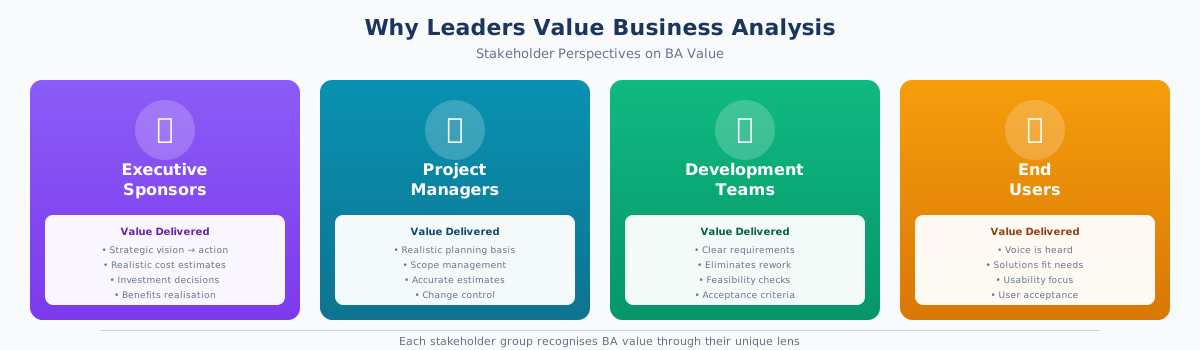
Executive sponsors, project managers, development teams, and end users each recognise business analysis value through different lenses. These perspectives collectively demonstrate why organisations with mature BA capabilities achieve superior outcomes across diverse measures.

Four stakeholder perspectives showing how executives, project managers, development teams, and end users each value business analysis

Executive Sponsors

Executive sponsors value business analysis because it translates strategic vision into actionable plans. When a chief executive articulates a digital transformation objective like "become a data-driven organisation", business analysts define what that means operationally: which business processes require data integration, what analytics capabilities different roles need, how decision-making workflows must change, and which cultural shifts are prerequisites for success. Business analysts provide executives with realistic cost and timeline estimates grounded in detailed requirements rather than optimistic guesses, enabling informed investment decisions.

Project Managers

Project managers value business analysis because it provides the foundation for realistic planning and scope management. Clear requirements enable accurate effort estimation, resource allocation, and dependency mapping. When scope change requests emerge—as they inevitably do—the project manager and business analyst can assess whether it represents genuinely changed business conditions requiring accommodation or simply incomplete initial elicitation that shouldn't justify schedule delays. Business analysts also provide project managers with detailed effort estimates based on requirements complexity, enabling realistic scheduling rather than arbitrary deadline commitments.

Development Teams

Development teams value business analysis because it eliminates the ambiguity that creates rework cycles. When requirements specify exactly which data fields a payment form must capture, what validation rules apply, how the system should respond to various error conditions, and what confirmation messages users expect, developers can implement correctly the first time. Clear acceptance criteria prevent the frustration of completing work only to learn it doesn't meet unstated expectations. Technical feasibility assessment by business analysts prevents developers from receiving impossible requirements like "process batch uploads within five seconds" when the data volume makes that physically impossible given infrastructure constraints.

End Users

End users value business analysis because it ensures their voices influence solutions. Too many technology projects impose systems that technically work but fail to support how people actually work. Business analysts conducting observation sessions discover workarounds users developed because existing systems have limitations, revealing requirements that interviews alone wouldn't uncover. They advocate for usability requirements that developers might dismiss as non-essential. They facilitate user acceptance testing ensuring solutions actually improve user experiences rather than simply checking technical functionality boxes.

Ready to Explore Further?

Explore the Types of Business Analysts

Now that you understand why business analysis matters, explore the different types of BA roles and career pathways available.